


The strip's popularity grew steadily over the next ten years, and as time passed Elzie Segar graduated from telling a new joke in each strip to developing story lines that went on for weeks, months and sometimes even years. In 1929, he came up with a story in which Ham and Castor decided to set sail in search of a legendary creature called the Whiffle Hen.

Neither Ham nor Castor knew anything about sailing, so they went down to the waterfront to hire a sailor to take them on their trip. In the June 17, 1929, strip, Castor walks up to a scrappy, one-eyed man with a captain's hat and asks him, "Are you a sailor?"
"Ja think I'm a cowboy?" the sailor replies. Popeye the Sailor Man was born.


Popeye was Max Fleischer's favorite comic strip, and in November 1932 he approached an executive with King Features Syndicate, the company that owned the Popeye strip. "You know, this is a nutty little creature, but I think I could do something with it," he told them.
"Out of that ugly looking thing?" the executive supposedly replied.
"The funnier he looks," Max Fleischer replied, "the better the cartoon will be."
Fleischer decided to test Popeye's appeal by featuring him in a Betty Boop cartoon. But fearing other studios would steal his idea and create their own sailor characters, he locked animator Roland Crandall in a studio, where Crandall spent the next several months animating the first Popeye cartoon by himself, in secret.
Betty Boop Presents Popeye the Sailor was a huge hit when it premiered in the summer of 1933 and a succession of Popeye cartoons followed over the next several years. Together, the cartoons and newspaper comic strips launched a huge Popeye fad; by the late 1930s Popeye eclipsed even Disney's Mickey Mouse to become the most popular cartoon character in the United States.
At its peak the Popeye craze was more than just a fad -it was a cultural phenomenon. The comic strip, which appeared in 638 newspapers around the country, was responsible for adding the words "jeep" and "goon" (both characters in the strip) to the English language.


 Popeye's intemperate nature served him well during the 1930s and the 1940s, when he and Bluto were given white U.S. Navy uniforms so that they could aid in the war effort. Popeye cartoons were a TV staple in the 1950s and 1960s, but the same thing that had made Popeye popular during the Great Depression and World War II started to work against him.
 Popeye's popularity slid in the 1970s and 1980s as parents began to worry about the amount of violence there children were watching on television.


Popeye received a makeover in 1987: He traded in sailing in favor of owning a health club, was married to Olive Oyl, and had a son named Junior (no word on what happened to Swee'Pea). Likewise, Bluto was married to a woman named Lizzie and had a son named Tank. The new series, called Popeye and Son was such a ratings disaster that it was pulled off the air ofter only 13 weeks.
According to one poll taken in 1991, Popeye had slipped to 92nd in a national poll ranking the popularity of cartoon characters.
At its peak the Popeye craze was more than just a fad -it was a cultural phenomenon. The comic strip, which appeared in 638 newspapers around the country, was responsible for adding the words "jeep" and "goon" (both characters in the strip) to the English language.


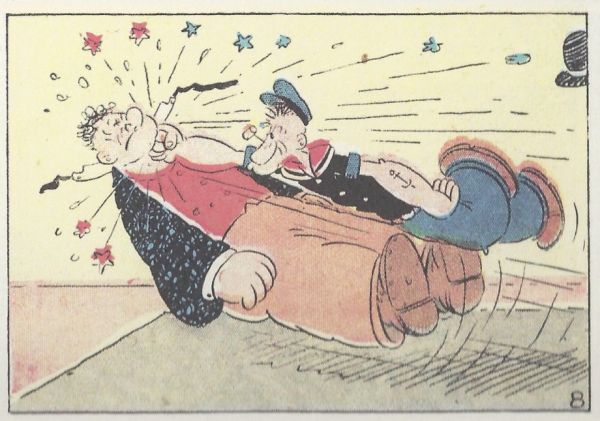
Fighting was part of Popeye's persona from the very beginning. He was the most violent in the earliest days of the comic strip, when he cussed, started fights, and often hit animals, people, and inanimate objects with little or no provocation. The scrappiness of those early cartoons were well suited for the audiences of the 1930s and 1940s. Bud Sagendorf writes in Popeye: the First 50 Years: "Though today it may seem brutal, Popeye's outlook was a natural reaction of the times. A population frustrated by the Great Depression liked the idea of one small man fighting back and winning. They, too, wanted to strike out at something they feared and didn't understand."


But as Popeye's popularity with children grew throughout the 1930s, King Features Syndicate owner William Randolph Hearst ordered Elzie Segar to tone down the cursing and the violence and make the strip more suitable for children. Popeye stopped cursing, but remained just as violent as ever, only now instead of fighting for no reason, Popeye always fought for what was right -no longer a brawler. Thanks to Hearst, Popeye was now a full-fledged hero.


Popeye received a makeover in 1987: He traded in sailing in favor of owning a health club, was married to Olive Oyl, and had a son named Junior (no word on what happened to Swee'Pea). Likewise, Bluto was married to a woman named Lizzie and had a son named Tank. The new series, called Popeye and Son was such a ratings disaster that it was pulled off the air ofter only 13 weeks.
According to one poll taken in 1991, Popeye had slipped to 92nd in a national poll ranking the popularity of cartoon characters.

The Popeye theme was written by Sammy Lerner. For years, he refused to admit publicly that he composed it- though he made a fortune from it, and it was probably his best known song.
Segar needed an explanation for Popeye's super strength. In the late '20s, health specialists were extolling the benefits of spinach as a super-food (erroneously, it turned out -due to a mistake made in calculating the amount of iron spinach contains), so Segar attributed Popeye's power to the vegetable.
Popeye is known as "Iron Arm" in Italy, and "Skipper Skraek" or "Terror of the Sea" in Denmark.
 In the old 1930s Fleischer Studios Popeye theatrical shorts, Jack Mercer was the voice of Popeye and Margie Hines the voice of Olive Oyl. They lived out the romance of the characters they played by getting married in 1939. The couple had spinach for their wedding breakfast.


